Yeomin Yoon
Professor Emeritus, Seton Hall University
Opinion Columnist, Diaspora
Summary
America can be regarded as having, de facto, a single ruling party: the Property Party. This party can be looked upon as having two divisions: the Republican Party (often dubbed “Conservative”) and the Democratic Party (“Liberal”). One difference between America and China (ruled by the Chinese Communist Party) is that politics in the former is not nearly as arbitrary, brusque, and doctrinaire as in the latter. But anyone who is carried away by the lullaby of American democracy had better study the harsh experience of African Americans and other repressed groups in the American political system. Notwithstanding the founders’ dream of an informed public, the American political landscape will not be able to sustain itself as a place for rational, civil, and peaceful deliberation if the politics (Aristotle called it the “culmination of ethics”) is ruined by so many Americans, who prayed to God before participating in sedition against American democracy on January 6, 2021. If America slit its throat in the act of “democide,” it would surely help the hyper-authoritarian (or totalitarian) China to achieve the “China Dream,” aka Pax Sinica, sooner rather than later. If Americans truly value democracy and want to avoid “democide,” they should value the ability of people at all levels of income and wealth to shape the government. That is what it means to be a democracy. In this sense, America is a plutocracy rather than a democracy.
Summary in 한글
미국은 사실상 ‘재산당(Property Party)’이라는 단일 지배 정당을 가진 나라로 볼 수 있습니다. 이 정당은 흔히 ‘보수(Conservative)’라 불리는 공화당과 ‘진보(Liberal)’라 불리는 민주당이라는 두 개의 분파로 나뉘어 있다고 할 수 있습니다. 공산당이 통치하는 중국과 미국의 한 가지 차이점은, 미국의 정치가 중국의 정치만큼 자의적이거나 거칠거나 교조적이지는 않다는 것입니다. 하지만 미국 민주주의가 지어 낸 자장가(lullaby)에 취해 있는 사람이라면, 미국 정치 체제 내에서 흑인이나 기타 억압받는 집단이 겪어야했던 가혹한 현실을 직시해 볼 필요가 있습니다. 건국 시조들이 꿈꿨던 “식견 있는 시민”의 이상과는 달리, 미국의 정치 지형은 합리적이고, 품위 있으며, 평화로운 토론의 장(場)으로서, 그 명맥을 유지하기 어려울 것입니다. 2021 년 11 월 6 일, 미국 민주주의를 뒤흔드는 반란 행위(폭도들의 국회의사당 침공)에 가담하기 직전, 신(God)에게 기도까지 올렸던 수많은 미국인들에 의해, 아리스토텔레스가 ‘윤리의 정점’이라 칭했던 정치가 망가져 버렸기 때문입니다. 만약 미국이 ‘데모사이드(democide, 민주적자살)’를 자행함으로써 스스로 목숨을 끊는다면, 이는 초권위주의(또는 전체주의) 국가인 중국이 ‘중국의 꿈(China Dream)’, 즉 ‘팍스 시니카(Pax Sinica)’를 조기에 실현하는 데 큰 도움을 줄 뿐 입니다. 만약 미국인들이 진정으로 민주주의를 소중히 여기고, “민주주의 말살”을 피하고 싶다면, 소득과 재산 수준에 관계없이 모든 시민들이 정부를 만들어갈 수 있는 권리를 존중해야 합니다. 그것이 바로 민주주의의 의미입니다. 그런 의미에서 미국의 정체는 민주주의라기보다는 소수의 금권주의 입니다.
A former college classmate living in Seoul who was visiting the US asked me recently, “What kind of democracy do you think Americans have today?” I responded to him as follows: “If you consider the following historical facts and observations, you can easily get your own answer.”
I. Historical Facts and Some Value-loaded Observations
On July 4, 2026, Americans celebrated the United States Semiquincentennial (250th anniversary) of the signing of the Declaration of Independence from British colonial rule. I wonder how many (young and old) American citizens realize that racism has been constitutive of politics in America on July 4, 1776, and thereafter. How many American history educators teach their students that the confident statement, “all men are created equal,” with “unalienable rights,” to “Life, Liberty, and the pursuit of Happiness” was written by a slave owner, Thomas Jefferson, and released to thirteen colonies that all, to one degree or another, allowed slavery¹? How many American students know that not only Jefferson but also George Washington, James Madison, James Monroe, and Andrew Jackson were slave-owning presidents of the early American republic?
In the US (and the European settler states), “race” in the sense of ethnic origin and physical appearance like skin color has been more salient than class to the history of democracy. In the Americas (and in Australia, New Zealand, South Africa, and Palestine), the main question of democracy has been, “Who are the people?” or “Are all races people?”
In these states, indigenous peoples were ignored for legal and political purposes, except as targets for violence and deportation. In the US, Native Americans (erroneously dubbed “Indians”) were not counted in the census until 1870. They were only granted citizenship in their ancestral land in 1924 – nearly one and a half centuries after white settlers had proclaimed that “All men are equal.”
During the colonial period (and many subsequent years), many American leaders legitimated the appropriation of land belonging to other (non-white) people. Moreover, when the British governor of Virgina, Lord Dunmore, proclaimed that slaves and indentured servants who enrolled with the British would be emancipated (see R. G. Parkinson, The Common Cause, Chapel Hill, 2026), George Washington, who was the owner of hundreds of slaves, labelled Dunmore an “Arch Traitor to the Rights of Humanity.” (See Eric Foner, “Tremendous in his Wrath,” London Review of Books, December 19, 2019) The decades after 1815 witnessed a deepening commitment to excluding all but free whites from membership in the American body politics. By the 1830s, the now-much-extended republic was strictly a nation of whites. (See Parkinson, The Common Cause)
Another salient example of racist leaders was Andrew Jackson, who was elected the seventh president of the United States by popular vote in 1828. Jackson was a genocidal racist, whose “Indian” (native American) clearances resembled the Ottoman removal of the Armenians in 1915. Universal suffrage (i.e., liberal democracy in the sense of competitive elections regardless of race, sex, and property) was achieved in the US only in the late 1960s. (See Göran Therborn, Inequality and the Labyrinths of Democracy. Verso. London. 2020)
1. See “America’s Original Sin: Slavery and the Legacy of White Supremacy,” by the eminent historian of American slavery and the law, Annette Gordon-Reed, Foreign Affairs, January/February 2018, pp. 2-7. Gordon-Reed is Carl M. Loeb University Professor at Harvard University.
II. The Property Party, with two divisions, rules America
One must be a member of the Chinese Communist Party (CCP) to participate in politics in China. To partake meaningfully in politics in the U.S., one must be a property owner, although this is not a formal requirement. Formally, anyone may participate. Informally, however, participation beyond voting for alternate preselected candidates is so difficult for the non-propertied Americans as to be, in effect, impossible. The non-propertied person in America who wishes to attain and hold a position of leverage in politics (beyond marginal individual leverage) must quickly become a property owner. Budding American politicians without property must find or create opportunities (legal or illegal) for themselves to acquire property. Without it, they shall be naked to the first wind of partisan adversity and gratuitous public spitefulness. Not all property owners participate in politics. When all the chips are down, however, big property owners rule or significantly modify the situation in committee rooms and cloakrooms, either directly or through amply rewarded intermediaries (aka, lobbyists for rich and super-rich).
Louis D. Brandeis (1856 – 1941), the noted American jurist and Supreme Court justice (1916- 1939), is known to have stated: “We may have democracy, or we may have wealth concentrated in the hands of a few, but we can’t have both.” Apparently, Brandeis made this statement during the Gilded Age to warn that extreme economic inequality destroys equal political power, pointing out that society must pick between shared power or vast fortunes for a tiny group; that huge wealth buys unfair political influence; and that true rule by the people cannot survive alongside an economic oligarchy.
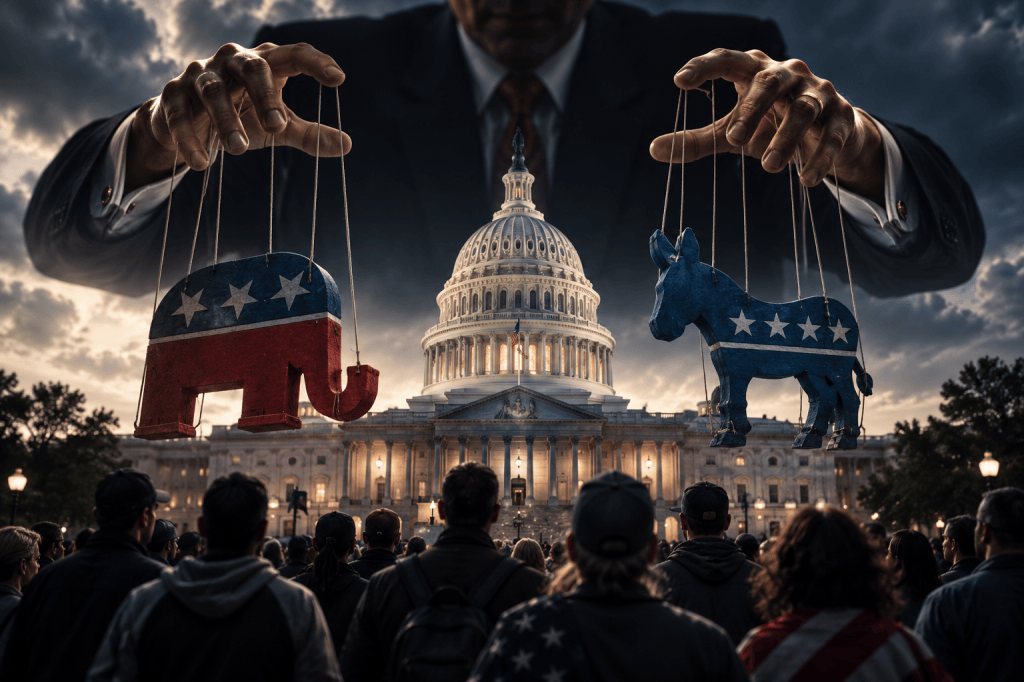
In this framework, the political systems of CCP-ruled China and the U.S. are not fundamentally as different as widely assumed. One party, called the Chinese Communist Party, rules China. America can be regarded as having, de facto, a single ruling party: the Property Party. This party can be looked upon as having two divisions: the Republican Party (often dubbed “Conservative”) and the Democratic Party (“Liberal”). In America, no substantial group of property owners has seen fit to underwrite third parties.
One difference between America and China is that politics in the former is not nearly as arbitrary, brusque, and doctrinaire as in the latter. But anyone who is carried away by the lullaby of American democracy had better study the harsh experience of African Americans and other repressed groups (like native Americans Columbus erroneously called “Indians”) in the American political system.²
There is another difference between the “superpower” and the “superpower wannabe.” Even though the former may look immature enough to keep telling the world that it is No. 1 to believe in its raison d’etre, it has been telling the world it is trying to defend (under the banner of Americanism) “universal values” such as human rights and democracy — although there seems to be only a dim prospect of such under the Trumpian rule. But the rulers of China find the universal values distasteful.
In this context, we should be reminded that China’s 1919 May Fourth Movement (五四運動) called for protection of human rights and democracy. The main thrust of this movement was the Chinese people’s demand for the “liberation of humanity.” Today’s China, however, appears to have completely forgotten the movement that was admired worldwide. Instead, today’s rulers of the country they proudly call “the only civilization that lasted more than 5,000 years” seem to focus on narrow and paranoid nationalism. Rather than pursuing the great May Fourth Movement’s ideal, the salient feature of the “Xivilization” (President Xi Jinping’s civilization) thesis seems to be the strong advocacy of “wolf-warrior” nationalism, not the human freedom the May 4th Movement demanded.
2. In my classes, I often likened the Republican Party and the Democratic Party to cola and diet cola, respectively. I also told my students that “both are junk drinks, and if you want to keep your body and soul healthy, you do not drink them.”
According to The Economist, “China’s nationalists can be surprisingly Trumpian. Some of them are even pro-Trump. To be sure, many of those who cheer for Mr. Trump do so out of contempt for America. They…sneer at his nominations for cabinet posts – don’t they prove what a sham democracy is, with jobs so flagrantly doled out to loyalists regardless of their suitability?… [China’s nationalists] refer to him by a nickname: Chuan Jianguo, meaning ‘Trump the Nation Builder’… they mean he is making China stronger by undermining America.” (See, “MAGA with Chinese characteristics,” December 14, 2024, p. 35.)
When I encounter my former Chinese students, I often ask: “When will China’s young generations be able to educate themselves well enough to resurrect the noble spirit of their ancestors’ May 4th Movement (五四運動)?” I was disappointed when I was subject to a recent interlocutor’s response: “Considering what’s happening in China today, you asked me an anachronistic question. But I can tell you one sure thing: many Chinese netizens enjoy witnessing a premonition of the rapid demise of American democracy and civilization unquestionably inflicted by America’s 47th president.”
There is another difference between America and China. In the former, a precarious democratic republic — now facing the danger of becoming a de facto oligopolistic plutocracy under President Trump — there is still the freedom to despair. However, in the latter, a totalitarian ‘civilizational state,’ there isn’t. Concerned citizens — especially young people — in the two countries should ask themselves what being a human and an American or a Chinese in the 21st century means when they decide what they must do for their country. Existential situations demand timely and brave actions. Human existence is a constant act of balancing being, knowing, and doing, with no way to choose one at the exclusion of another. That is the human condition.
III. Will the American political landscape remain a place for rational, civil, and peaceful deliberation?
In the 2024 presidential election, many American voters, including a substantial percentage of Latino Americans and young voters who used to vote for the Democratic Party, seemed to have made a difficult judgment and done a treacherous experiment by voting for Mr. Trump as president.
I lay a wager that after one and three-quarters years of experience with the plutocracy à la Trump, many of these voters now wish that Biden were still in office or that Harris continued Biden’s seemingly lukewarm or lackluster governance. Under the remaining two and a quarter years of the Trumpian regime, I expect many conscientious and intelligent people of this nation will find anarchy, more corruption, more division, and more poor people rather than peace, prosperity, righteousness, and unity. American people have been, and will be, subject to more lies, more damned lies, and more dissembling – the marketing trick of mixing lots of lies with a modicum of truth to fool the people. While, domestically, Americans are subject to soaring violence, crimes, homelessness, and drug addiction, on top of what the late President Jimmy Carter called rampant “legal bribery³,” or legalized corruption, internationally, President Trump and his entourage will intensify the “contempt for America” on the part of her real and potential adversaries. Moreover, the accelerated “America First” policy, reflecting arrogance and ignorance about the world beyond a Trumpian America, has alienated U.S. allies.
Domestically, the mechanics of malfeasance permeating the American political economy will be strengthened during the Trumpian rule. Such mechanics mean the mighty lobbying power wielded by big corporations whose principal interests are synonymous with those of the rich and super-rich Americans. America’s big corporations, including another MAGA (Meta, Amazon, Google, Apple), are not accountable to most Americans. They will keep sacrificing the latter’s well-being to the pursuit of their own separate interests and inclinations. In other words, what Jimmy Carter called “legal bribery” will intensify and plague America’s political process and its national economy.
One of the major problems facing America is how the nation can remove or control the mechanisms of corporate malfeasance, namely, fixing corporate lobbying and monopoly power that reduces competition. Business competition in markets is a primary strength (even a lifeline) of capitalism. Given the quality of a product or service, competition keeps its price low for consumers and end-users.
Corporations with record profits in a healthy competitive economy absorb higher costs, e.g. higher wages to workers. Instead, they will easily pass the costs on to consumers through higher prices, because the government, like today’s Trumpian one, will condone corporations doing so. And they can because they don’t face meaningful competition due to the weak, ineffective antitrust regime. Big corporations will take as much as they can from consumers. Publicly, however, the company will blame rising material costs for their increased prices. In a healthy economy, corporations pay higher wages from their profits rather than pass them on to consumers in higher prices. Don’t expect them to do so now.
Instead, expect big corporations to become fatter. Workers will not have power; corporations will. Forget the preferable set of weapons against inflation and “economic rents” (“free lunch, dinner, and breakfast”): tougher antitrust regime and enforcement, a windfall profits tax, and, if necessary, even price controls. Forget the whole thing under Trump.
Another grave concern is that, notwithstanding the founders’ dream of an informed public, I doubt that the American political landscape will be able to sustain itself as a place for rational, civil, and peaceful deliberation, if the politics (Aristotle called it the “culmination of ethics”) is ruined by so many Americans like those shown in the Reuters photo (see below) of January 6, 2021, who prayed to God before participating in sedition against American democracy.
3. Former President Jimmy Carter famously used the phrase “legal bribery” in Atlanta, Georgia, on July 17, 2013, during a panel hosted by the Carter Center regarding U.S. elections.
[여기에 원본 PDF 7페이지의 사진 삽입]
Source: The Commonweal Magazine, January 8, 2021
I bet the people in the above photo who attacked the Capitol after their prayer believed God was on their side. I wonder if God often wonders who is on His side.
Federal officials estimated that about ten thousand rioters entered the Capitol grounds, and the Secret Service and FBI estimated that from 2,000 to 2,500 ultimately entered the building.
When this mob of supporters of President Donald Trump attacked the United States Capitol in Washington, D.C. on January 6, 2021, it prompted academic debate about whether to characterize the event as a coup, an attempted coup, or neither. The attack happened two months after Trump’s defeat in the 2020 presidential election. Attackers sought to keep Trump in power by preventing a joint session of Congress from counting the Electoral College votes to formalize the victory of the president-elect Joe Biden.
This violent event made it clear that the gravest threat to American democracy was not Islamist terrorists but America’s own citizens who were goaded by an autocratic president to whom American voters handed vast powers. As the prominent legal scholar Rosa Brooks (the Scott K. Ginsburg chair in law and policy at Georgetown University) points out: “In 1776 the American colonists rebelled against what they saw as the arbitrary and tyrannical British monarchy…, it’s not hard to imagine Mad King George gazing out at Donald Trump’s America – and laughing.” (See her essay, “How the war on terror primed America for autocracy,” The Economist, June 13th, 2026, p. 31)
To some Americans’ eyes, today’s China may not be ten feet tall⁴. If America slit its throat in the act of “democide,” however, that would surely aid the hyper-authoritarian (or totalitarian) China to become more than ten feet tall and achieve the “China Dream,” aka Pax Sinica, sooner rather than later.
4. See Ryan Hass, “China Is Not Ten Feet Tall: How Alarmism Undermines American Strategy,” Foreign Affairs, March 3, 2021.
IV. Concluding Remarks
I often hear my American friends telling me that “We, Americans, value democracy.” I keep reminding them that “If you value democracy, you should value the ability of people at all levels of income and wealth to shape the government. That is what it means to be a democracy. In this sense, America is a plutocracy rather than a democracy.” [THE END]
Author’s biographical information
Yeomin Yoon, Ph.D., is a professor emeritus at Seton Hall University and an opinion columnist for Diaspora, Journal of the Korean Professionals International (KPI). After spending fourteen years as a senior economist and general manager of international joint ventures at one of the largest American corporations, he taught global business and engaging the world (a multi-disciplinary course) and international finance for thirty-three years at Seton Hall’s Stillman School of Business until January 2022. Yoon also served as a visiting professor at the University of International Business and Economics in Beijing and Seoul National University in South Korea. As a corporate finance advisor to a U.S. Agency for International Development (USAID) program, he taught corporate finance and international finance to the economics faculty of eight universities in the former Yugoslavia. Additionally, Yoon served eight years as a senior special fellow and academic advisor of the United Nations Institute for Training and Research (UNITAR) for a program designed to train diplomats and other government officials of the U.N. member states on global economy and finance.
 <strong>Korean Professionals International</strong>
Leave a comment