
(This article is a revised version of a paper presented at “Symposium with World’s Leading Scholars” held in Seoul, Korea in July 2025, with the title, “Re-designing the Market Economy: Empathetic Capitalism.”)
Jang-Hee Yoo (National Academy of Sciences, Korea)
Abstract
The traditional capitalism that has about 250-year history since The Wealth of Nations of Adam Smith has long been on the table of criticisms. There have been many economists who criticized the modern capitalist system, many of whom are even viewed as theorists in the traditional main-stream economics. The focal points of the criticisms include inequality in income and wealth, market failures, natural monopoly, mismanagement of cyclical chaos, and failure in curing poverty. This study revisited some of the major theories that pointed out demerits of capitalism and attempted to offer an alternative structure to the conventional capitalistic system that may make the society fairer and happier.
In doing that, this study viewed altruism is a very important part of internal mechanism in human natural thinking, and therefore, people’s economic behavior should be re-interpreted, including the fact that they do care for neighbor’s welfare when they make an economic decision in the market place. This study proposes one more sector dealing with human beings’ altruism in addition to the market sector and the government sector. This study names it “Goodcommon” indicating all the people who would like to contribute to the welfare of the society in good will gather together to form an independent mechanism in parallel with government and market.
It consists of six functional divisions: receiving, distributing, administrating, public relations, corporations and finance. It is operated independently yet with close cooperations with the other two sectors. This study proposes that the Korean economy would be used as an exemplary case to introduce the empathetic capitalist system with the goodcommon.
Abstract in 한글: 공감자본주의론(共感資本主義論) 요약
애덤 스미스 이래 경제학 이론의 주류를 형성하고 있는 자본주의 시장경제가 근년에 이르러 여러 유명 경제학자들로부터 비판을 받고 있음. 그 비판의 주요 내용은 부와 소득의 불평등, 빈익빈 부익부 현상, 승자 독식의 모순, 시장실패, 경기의 불안정 등임. 이러한 현상이 나타나는 이유는 이른바 “보이지 않는 손”에 의해 시장은 자율적으로 움직이며 외부의 충격이 없는 한 안정성장을 이루어 나간다는 서구식 자유주의가 너무 오랫동안 경제학 이론의 핵심을 차지하고 있었기 때문임.
본 연구는 인간의 내면에 자리잡고 있는 이웃을 의식하고 상부상조하며 자기들이 속해 있는 사회가 밝고 훈훈해지기를 원하는 겸애(兼愛)의 욕구도 중요하다고 보는 심리가 반드시 존재한다고 보았음. 효용극대화나 이윤극대화도 중요하지만 그동안 기존 자본주의가 크게 주목하지 않고 있던 공감(共感)의 영역도 목적함수에 들어가야 한다고 믿었음.
특히 급변하고 있는 정보화, AI화 시대의 시장질서는 시공을 초월하여 다른 이들의 시장선호를 순식간에 파악할 수 있는 질서로 변화하고 있음. 이를 배경으로 본 연구는 한 국가의 조직을 정부와 시장이라는 2분법의 고정관념에서 벗어나 정부, 시장, 그리고 공선부(共善府)라는 3분법의 체제를 제시함으로써 자본주의 비판론자들이 지적하고 있는 제반 모순을 개선해 나갈 수 있지 않겠느냐라는 새로운 가설을 제시하였음.
본 연구는 공선부 설치의 가능성에 대해 먼저 어느 나라를 모델케이스로 선택하는 것도 좋은 방안이라고 제안하며 을 개국 이념으로 삼고 있는 한국을 그 대표적 시험 모델로 선정해도 좋지 않을까 하는 아이디어를 내어 놓고 있음.
또한 본 연구는 공선부가 출범할 경우 그 운영 방식에 대해서도 세부적인 내용을 제시하고 있음.
Table of Contents
I. Introduction
II. Humans and Nature
III. Altruistic Capitalist System
IV. Integrated Model
V. Operating Body of the Empathetic System: Gongsunbu (Goodcommon)
VI. Role of Gongsunbu
VII. Possibilities of Gongsunbu
VIII. Conclusion
I. Introduction
Capitalism, with its 250-year history known to have begun with Adam Smith who wrote The Wealth of Nations back in 1776, has often been criticized by many well-known economists, including Karl Marx. Major criticisms aim such weaknesses of capitalism as income inequality, monopolistic power, winner-takes-all syndromes, and unnecessary business cycles. Some of the liberal economists even propose to reform the capitalist system in such a way that the roles of government should be expanded so that the nation’s income would be equally distributed.
As the world entered the 21st Century, with the acceleration of the IT and AI revolution, human society is transforming into a society where all information, knowledge, experiences, and even individual desires and hopes are completely open through electromagnetic waves. The society is becoming one where there is no material distinction between “mine” and “yours”, and collaborative systems through the internet, digital platforms, AI, etc., are expanding widely. Thus, emphasizing utility maximization and profit maximization that were highlighted in the past capitalist market economy seem to be gradually fading. It is becoming a world where the optimization created by collective intelligence is swiftly formed, and society members share the optimal solutions created by collective intelligence.
The principle of protecting private property rights, which was considered as a backbone in the past as a means of wealth and power, is no longer absolutely significant. If one knows how to create and operate blockchains, their property rights are automatically guaranteed without the need to artificially support ethics or morals. Due to the mechanism of instant dissemination of information and consensus building through communication, those who commit wrongdoing are automatically expelled without anyone having to catch them. Society will transform into a non-hierarchical society, becoming completely transparent with a high level of mutual assistance.
The order generated in such a society will become public capital called social culture, and therefore, under that order, there may be no reason for market failures such as inequality, unfairness, winner-takes-all, loser-falls, or great market destruction to occur.
To prepare for a new capitalist system that will emerge soon, a system that could eliminate inequality, prevent market failures, and harmonize between classes, which the conventional capitalist system has not succeeded for, could be designed. To achieve this, the current two-sector model, namely the system with the market and the government, must be changed. The market or the government will not be able to operate such decentralized and super-communicating economy of the 21st century. It is still true that the market is where sellers and buyers gather together. However, in the 21st century, people come to the market with very different motives from those of sellers or buyers like Adam Smith had in mind in his The Wealth of Nations.
They are not like the old-fashioned people who compete and choose only on the conditions that are advantageous to themselves for selling or buying. They are the people who have come to form collective intelligence that everyone involved can agree upon. They do not shout the desired price commonly seen in an auction site. There is no need to do so because they already know through the Internet or AI information what the market price will be and how much quantity can be secured before they come. It is not a system where transactions are concluded by the “invisible hand” in the market but a system where one already knows necessary market information through “invisible electromagnetic waves” before they come.
The shift in decision-making processes of these individuals signifies a departure from the mindset that individuals gather to create a system in the past, and inevitably, humans are transforming into beings who rely on pre-existing systems from ancient times and seek harmony through mutual participation and adherence to sharing. Jeremy Rifkin interprets this as an understanding of a new biosphere. Essentially, the original physical laws of the Earth have already been operating under a meticulous order, and humans simply fail to realize this. With the help of advanced technologies such as IT, ICT, and AI, people have begun to identify the fundamental forces driving the Earth’s movements, and it is considered natural and inevitable for people to enter into these forces.[1] What emerges here is what is known as a system theory.
This theory challenges the Darwinian evolution theory, which posits that only the fittest survive through competition, by asserting that organisms on Earth survive by appropriately digesting the given environment through mutual participation and cooperation among organisms. In essence, the biosphere has always existed, and the various materials on Earth that humans utilize, such as electricity, chemistry, machinery, and temperature, are considered to have been obtained through the evolution process of mutual assistance among the materials existing on Earth. According to the system theory, the Earth is viewed as a living organism with self-regulating functions, and the geological, botanical, and atmospheric chemical compositions mutually interact to facilitate life activities.
It is necessary to consider the Gaia Hypothesis proposed by British scientist James Lovelock in the 1970s. This theory suggests that the entire Earth operates similarly to a single living organism. The core of this hypothesis is the concept that the Earth’s organisms and inorganic elements interact with each other to self-regulate and maintain the Earth’s environment. In other words, the existence of a self-regulating system allows the atmosphere, oceans, soil, and organisms to interact to regulate temperature, atmospheric composition, salinity, wind, sea level, etc., creating and maintaining an environment where organisms can continuously survive.
This mutual interdependence has always existed, and organisms and the environment are directly connected, detecting each other’s changes and responding appropriately. For example, plants release oxygen through photosynthesis, which aids in animal respiration. Through this continuous interaction between organisms and the environment, overall stability on Earth is maintained. This theory has had a significant impact on development of environmental science and ecology, providing a key insight into the mysterious interdependent relationship between humans and nature.[2]
II. Humans and Nature
If one acknowledges the validity of such a hypothesis as Gaia, one could consider that in the decision-making process of humans, instinctively or inherently communicating in harmony with natural phenomena would lead to the most free and harmonious formation of conclusions. Due to preconceived notions that this might be difficult, it has not been widely adopted in mainstream economics. However, with the universalization of technologies such as IT, IoT, metaverse, blockchain, AI, etc., it can be anticipated that humans will actively form extensive networks within the biosphere and acquire the necessary information and knowledge for their decision-making processes in an accelerated speed.
By sharing information, technology, knowledge, and experiences among all members of the society, there have been numerous instances where societal development, as well as global economic development, has been significantly accelerated. A prime example is Tim Berners-Lee, who invented the World Wide Web (WWW) and decided to share it freely with humanity. While working at the European Organization for Nuclear Research (CERN) in 1989, he conceived the WWW system to facilitate easy information sharing. By inventing HTML (Hyper Text Markup Language) and HTTP (Hyper Text Transfer Protocol), he created a system that allows data and language to be freely and infinitely used through the Internet.
He designed it in a way that anyone with Internet access could use it for free without patenting it, and further refined it by announcing W3C standardization results, which also made it freely available to everyone.
The philosophy of Tim Berners-Lee is that in a world where the Internet is spreading quickly and freely throughout the world, just like air is freely provided to everyone in the world, communication and information sharing should be freely and openly shared among all people. Thanks to Tim Berners-Lee’s decision today, IT, digital, mobile, and AI cultures are spreading worldwide, and human society is experiencing incredible transformations and developments as a result. In all fields such as politics, economy, society, culture, arts, and sports, a “miracle of empathy” is being created. Even for countries where democracy struggles to take root due to lack of communication, the introduction of the WWW system and the spread of the Internet and mobile communication have made it easier to find out the way to reconciliation and to build peace.
Likewise, in a society where the market is not functioning well, a quick information system makes the establishment and development of a fairer market order easier. For example, when information spreads so instantly that a certain large corporation is taking advantage in the market too much, consumers would quickly change their purchasing choices towards other corporations, leading to market equilibrium prices and quantities easily and more quickly to a more rational level.
Dr. Tim Berners-Lee’s contribution is therefore enormous, and it could be called revolutionary. Not only his creativity but also his humanly dedicatory mind has moved many people’s hearts. What would have happened if he registered it with the patent office made it his own private property? It goes without saying that Dr. Tim Berners-Lee would have become a millionaire, and due to expensive fees, only those with significant financial resources would have been able to use it. Skilled and rich individuals who could use it would have effectively utilized this technology in the market to maximize their profits. Meanwhile, developing countries without the resources to utilize this technology would have been delayed in benefiting from the Internet culture, and domestically, those unable to utilize it would not have been able to access new cultures and technologies, thus hindering their income growth.
In other words, internationally, there would have been a widening gap in GDP between countries, and domestically, there would have been an income inequality worsening between social classes. The fact that the WWW system was provided to everyone for free can be evaluated as the heroic decision through which the capitalist society was protected from further exacerbating inequality and unfairness.
The world is changing not only by the technological progress but also by many ethical or emotional leaderships. In recent years, there are many examples of emotional, mental, and psychological cultures spreading, leading to the creation of very peaceful and love-filled communities. Here is an example, that is, the program El Sistema in Venezuela. El Sistema is a music education program for young people founded in 1975 by Jose Antonio Abreu, an economist and musician from Venezuela. This program provides hope and opportunities for impoverished youth through music, serving as a leading example of empathetic leadership that has brought about social change.
The program provided instruments for free and conducted music education for youth growing up in economically challenging environments. As a result, these youth were able to escape the temptations of crime and drugs, engaging in wholesome activities. Through music, they regained self-esteem, learned cooperation and discipline, and became aware of their roles as members of the society. The youth who grew through this program went on to become world-renowned musicians or music educators, contributing to the development of future generations. A prominent example is Gustavo Dudamel, a world-leading conductor from Venezuela who grew through El Sistema.
He has gained global fame through his talent and is recognized as a significant figure in his society, transforming it through volunteer work in the manner he learned and grew.
El Sistema’s success stories are widely known internationally, inspiring programs in various countries such as the United States, the United Kingdom, and Korea. It has become a catalyst for spreading awareness that cultural gaps among socially marginalized groups can be bridged, and that music can serve as a tool for social integration. El Sistema demonstrates that music, beyond being a mere art education, can create warm and beautiful emotions between individuals, leading society to develop in a positive direction and providing a means to heal and address various issues within that society. The insights that El Sistema offers us are threefold. Firstly, Dr.
Abreu did not just see the disorder, crime, corruption, and despair in the impoverished neighborhoods of Venezuela, but also discovered the good qualities such as human kindness, compassion, empathy, artistic pursuit, and beauty. With the hope that spreading these positive aspects among the youth could naturally purify the society, he utilized music as a connecting link to draw out the emotions hidden within the youth. This highlights the presence of a leader who envisioned the potential for societal advancement.
Secondly, there was financial support available to purchase musical instruments to provide them to the children free of charge. In other words, when Dr. Abreu explained his plan and requested support, some private entrepreneurs did not hesitate to provide financial assistance. Even in a corrupt society, when appealing to work together towards a common good, there are always companions. They were as dedicated volunteers as Dr. Abreu.
Thirdly, the government did not intervene at all in the establishment and operation of El Sistema. El Sistema was a completely privately-run volunteer organization founded and supported by the private sector.
By combining the two examples above, i.e., Tim Berners-Lee and Antonio Abreu and by integrating three points mentioned above, it can be understood that there are leaders in society who confront the problems of society in a positive direction, and there are neighbors who participate and support the intentions of those leaders. In such cases, it can be seen that even in areas or tasks where the government cannot intervene, solutions can be easily found if the private sector makes efforts. Even in a capitalist system with various unresolved issues, cooperation among the people who make up that society can create a consensus, and if a system operated in this manner is possible, one may argue that a system of empathetic capitalism would also be possible.
In the above anecdotes, it was revealed that in capitalist societies, knowledge, information, exploration, and tracking are spreading almost barrier-free due to the rapid progress of the digital and AI revolutions. If Dr. Tim Berners-Lee’s dedicated spirit of technology sharing or Dr. Antonio Abreu’s systemic social purification spirit spreads in a decentralized capitalist manner, capitalist economies can develop into a much more humane and gentle form. Here, as a new axis of capitalism (One may call it empathetic capitalism), some new design of capitalism could be introduced with a new, symbiotic system in which people shares information, knowledges, values, emotions, ethics, and even economic benefits among themselves.
III. Altruistic Capitalist System
As emotions, ethics, and sharing minds are coming in to the picture of capitalism, we may need to revisit some of the major ethical theories along with various institutions and systems that are fairly close to the models those theories quoted as examples. In many countries there are quite a few altruistic organizations, such as voluntary organizations and charity organizations. Furthermore, we note that they not only exist but also their roles are becoming increasingly important these days. To explain this, it may be a good idea to review some major ethical theories such as Levinas’ altruism, the philosophy of Naohiko, the concept of “Rerum Novarum” in religion, the universal love of Motzu (墨子), and the humanism of Hongik.[3]
Levinas believes that within the inherent nature of human beings, besides the joy of increasing one’s own interests, there is an invisible response that comes from others expressing gratitude for making them happy, which is already transmitted in his heart, thus receiving the gift of “worth” himself. This is supported by an anecdote that occurs annually in Jeonju, South Korea. In Jeonju, Jeollabuk-do, an anonymous donor meticulously packs a considerable amount of money in an envelope every year and leaves it in the police station yard without anyone knowing. Inside the envelope, it simply says, “Please distribute this money to those in need.” The location where the envelope is left each year is not fixed.
The only commonality is that it is either in a police station or a police box yard. The Jeonju Police Department, out of gratitude, earnestly requested through public broadcasting to send a thank-you note to this person without revealing their identity. A few days later, an anonymous postcard was delivered to the police department. Its content was that the gratitude of everyone had already reached the donor’s heart, so he/she was very happy, and he/she requested not to send any thank-you notes any more.
This folklore in Jeonju has been happening annually for over 20 years, and it seems to have served as a stimulus. According to the announcement by the Jeonju Education Office, at the end of each year, there are quite a few students in various schools who voluntarily collect donations to help less fortunate students and deliver them to the school principal. Although it is unknown who donates and who receives the donation, those who receive it will surely send their gratitude to the donors (whom they do not know), and the donors, although unseen, indirectly sense their gratitude coming back to them and are satisfied. It can be seen that Levinas’s ethical theory is functioning in reality. That is, a giver is satisfied with just knowing that the receiver really appreciates it and its effect does not stop there but it spreads throughout the community.[4]
Naohiko’s “There Comes the Sharing Economics” is not a mere extravagant theory. It is necessary to consider his argument that we urgently need to start exploring a new economic structure where everyone can live well, taking into account the 4th industrial revolution of the 21st century that he emphasized in “Us-ism.”[5]
With the advent of the digital transformation era, major economies around the world are demanding bold reforms in traditional industries of the 21st century, and the emerging IT and AI technologies are driving the emergence of new industries. Faced with the realistic pressure that major countries relying heavily on manufacturing and petrochemical industries must innovate their industrial structures in the era of such transformation, there is a shift towards a new way of life that focuses on finding a path for humans to live more broadly and deeply humanely, rather than emphasizing the maximization of ownership or profit as traditional economic principles have emphasized.
Due to this new trend, there is a phenomenon where the proportion of services and retail industries is increasing more than that of manufacturing, agriculture, and construction industries in major countries. In terms of employment, the service sector in both the private and public domains is becoming more active than the manufacturing, construction, and agriculture sectors. It is transforming into what is known as a post-industrial society. As these major service sectors utilize digital, IT, and AI technologies, humans have more free time available, leading them to seek a higher meaning of life beyond mere survival, and thus, social desires, self-realization, and self-actualization emerge.
The sentiment of caring for oneself and one’s neighbors begins to operate after all.
These changes are giving rise to a new set of values that question the traditional utilitarian maximization or profit maximization that individual (or corporate) objective functions emphasized in traditional neoliberal economics. If we integrate Naohiko’s arguments, the concept of “empathetic capitalism” becomes clearer.
The religious doctrine of “Rerum Novarum,” mentioned in Naohiko’s Wakachiai No Keizaigaku[6], is also receiving attention these days. Originally presented by Pope Leo XIII in the late 19th century to address various contradictions of capitalism, this doctrine emphasizes that while individual freedom and property rights are valuable, when used selfishly for one’s own benefit, they do not receive blessings from heaven. Therefore, the doctrine implies that when those who have given for those who do not, when employers dedicate themselves to their workers, and when those in power serve the weak, capitalist society can develop significantly by reducing various contradictions. It suggests that when everyone holds justice, public welfare, love, and compassion in their hearts and moves in the same direction, human dignity, social justice, the sanctity of labor, and high ethics can thrive without major contradictions in capitalist society, allowing humans to live happily. In essence, it seems to be a critical evidence of altruistic capitalism.
Reflecting on Catholicism’s “Rerum Novarum,” one can discover its resonance with Motzu’s doctrine of universal love (兼愛論). Universal love means treating others equally and loving them as oneself. All order in the world is sustained by love, and without love, society falls into chaos, leading to attempts to dominate each other by force. This is greatly expanded into conflicts among people and even wars between nations. While it may seem similar to Confucius’s teaching of “love people,” fundamentally, it differs. Confucius’s love refers to “love among those who are liked,” while universal love in Motzu’s theory means establishing relationships of mutual respect among all humans more broadly and equally, creating a relationship of mutual benefit between individuals.
Motzu, who believes this is possible, is perhaps in line with Mencius’s theory of benevolence and righteousness. Unlike Western philosophy, which seeks to understand human nature solely through instrumental reason, Mencius viewed humans as beings who cannot bear to see others suffer, known as “Your neighbors are yourself.” This is also known as the heart of compassion. In this sense, Mencius and Confucius are within the same philosophical vein, emphasizing not only the selfish aspect of human nature but also the altruistic aspect. However, Confucius’s doctrine of universal love emphasizes normative aspects more strongly, while Motzu’s theory stays firmly on voluntarism.[7] It is surprising indeed to find that it was found as early as 2,500 years ago in the Chinese history.
According to Motzu, humans are able to live rationally not because they have the ability to be rational, but because there is a heavenly law that governs humans. By divine command, humans believe that it is their essential mission to love and serve others as if they were their own, and to love and care for the children and parents of others as if they were their own children and parents. Among scholars of Eastern philosophy, Mencius’s theory of humility is also a subtle connection between humility and reciprocity: love as the cause and benefit as the effect.[8] Humility results in mutual benefit, and benefit can be understood as the basis for supporting love.
In other words, humility is both a consideration for the good of others and a safeguard for one’s own good. Ultimately, it is the act of creating common interests in an interdependent social relationship.
In terms of economic relationships, Confucianism regards it as righteous (公利) to value the interests of small and medium producers and to increase their profits. It also recognizes that working diligently and ensuring the best productivity is not only beneficial (利) but also righteous (義). Furthermore, it states that righteousness (義) is essentially beneficial (利), and injustice (不義) is essentially harmful (害). It argues that being loyal to one’s employer and filial piety towards parents are also beneficial to them, hence falling under righteousness (義). However, it is not always the case that righteousness (義) accompanies benefits (利). It depends on what the purpose of the benefit (利) is. Benefits (利) that are limited to individuals cannot be considered righteous (義), and it can be said that righteousness (義) is when benefits (利) circulate back to the entire community. This perspective is distinctly different from the individualism advocated in Western philosophy.
However, in the midst of Confucianism’s arguments, there is no clear explanation as to whether altruism is as inherent in human nature or instincts as egoism. Nevertheless, it seems that due to the egoistic nature of humans, which necessitates norms and regulations to maintain social order, just as a laissez-faire, economic order can operate effectively, and altruistic nature can also be effectively manifested when there are effective incentives. Therefore, Confucianism’s doctrine of benevolence entails numerous inherent incentives. As an incentive, Confucianism suggests that it is good to offer substantial rewards for love, friendship, benevolence, respect, filial piety, and loyalty. While setting penalties to ensure egoism does not cross certain boundaries is a Western approach to forming order, Confucianism’s doctrine of benevolence argues that it is good to provide many rewards (incentives) to derive altruism. Thus, while voluntary altruism is certainly possible, it is also possible to spread altruism by using appropriate incentives to induce it.
The founding concept of the Gojoseon Dynasty (in ancient Korea) was “Hongik human”. This philosophy is based on humanism and emphasizes that in order for human society to be a happy society, it is necessary to reject injustice among human beings, eradicate negligence, and aim for a society where autonomy and freedom are guaranteed. This was carried over to the current Korean era, where the Hongik spirit was incorporated into South Korean educational philosophy. We believe that this spirit provides an important foundation for designing a new capitalism, because when human beings interact and communicate with each other, building trust, exchanging necessary information, and cooperating is the way to eliminate inequality and achieve a “win-win” solution. The core idea behind the word “Hongik” is the same as the word “together”: the idea of building a wealthy society through mutual endeavors so that the precious results are shared, not monopolized by a few. It is a concept that is crucial to find out a solution for the problems of inequality in capitalism today.
IV. Integrated Model
Going back to the criticisms of traditional capitalism, we may summarize and consolidate them into five main points. These include the greed of capitalists, resistance from workers, the absence of social solidarity (共同善), political indifference to inequality, and the failure to establish desirable group consciousness.
One clear thing is that traditional economics has been “outcome-oriented,” where the human objective function has been predetermined and the focus has been on finding the optimal results under given constraints to satisfy human desires (whether individual or corporate). Therefore, if a solution falls short of achieving the goals that humans aspire to, it is not considered to be the correct answer in traditional economics. In traditional economics, the judgment of whether a goal has been achieved or not is largely based on material outcomes. Therefore, regardless of whether it is an individual or a company, it should be understood that there are no emotional variables within the objective function handled by economics.
For example, consider individuals or companies looking to participate in the stock market. They may have expectations of joy when participating in trading in the stock market and gaining. However, they feel disappointed when facing losses, or feel relieved when just observing the market without directly engaging in buying when the market is going bad. All of these are not accounted for in the objective function in the traditional economics.
Furthermore, not only the psychological expectations about oneself but also the economic “burden” felt by individuals or companies when they feel they have not done much for their own social contribution or the welfare of the society to which they belong, are not included in the objective function of traditional capitalist economic theory. However, fortunately, behavioral economics, which began to emerge in the 1980s, started to address this. With the acceleration of digitalization in various industries and fields, psychological preferences of market participants and the visibility and transparency of market information are becoming enhanced, leading to the emergence of analytical models incorporating “emotions.” By incorporating the psychology and emotions of market participants into variables, economic issues that were not well resolved in traditional economics are beginning to be resolved.
For instance, when there is a lack of trust between parties A and B and their arguments are at odds, negotiations between A and B do not take place. However, using probability models that also consider psychological reactions, proposing suggestions based on the study results that include satisfaction levels from numerous similar past cases can convince both sides to easily reach an agreement through such digital analysis.
The concept of “Distributive Capitalism” introduced by Jeremy Rifkin is similar to the above.[9] That is, it is believed that among human instincts, there is a clear inclination to collaborate with others when given opportunities. There is a desire to pursue common good through collaboration, and this has become distinctly feasible in the digital society. As individual preferences become known, information can be transparently utilized, and when accumulated records from the past show the benefits brought to individuals through collaboration, it becomes convincing that there should be changes in the existing market economy model. As universally acknowledged, Wikipedia has evolved into a more perfect encyclopedia through collaboration of people worldwide, and Tim Berners-Lee made the World Wide Web freely available to all humanity, opening up a path for communication through the Internet.
By combining the three elements proposed earlier— elements of symbiotic capitalism (where common goods are shared), altruistic capitalism, and the market economic elements originally contained in conventional economics—a theory of <Empathetic Capitalism> that everyone can consent can be created. It could be summarized into <Figure 1> below.
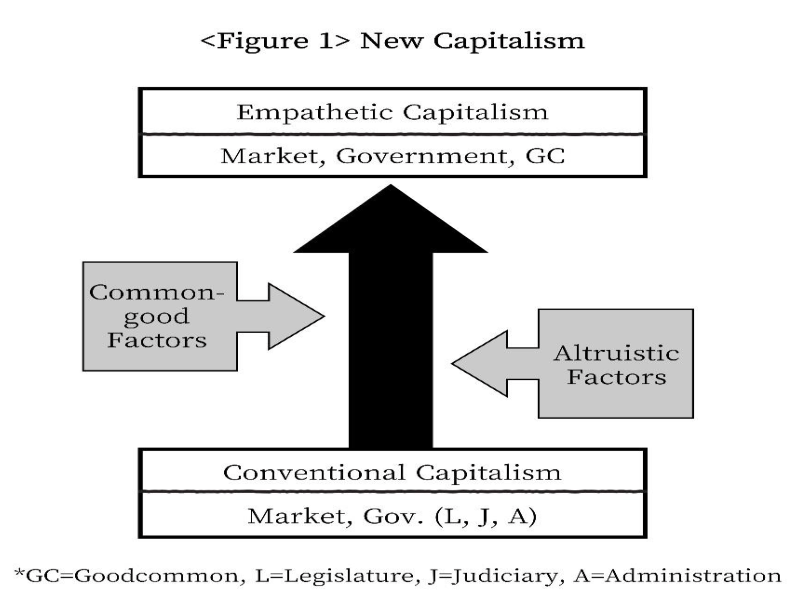
Adam Smith’s “The Wealth of Nations” did not include emotional elements such as a sense of responsibility among people participating in the market, consideration for others, empathy, sympathy, compassion, and the inevitability of sharing. However, it was noted that Smith, not only as an economist, philosopher, and jurist but also as a psychologist, showed a psychological aspect. Therefore, if we call Smith’s capitalism conventional capitalism, it is thought that a new theory of capitalism, including the personality traits emphasized by Smith himself or psychological elements of human beings, could be constructed. Furthermore, a high-level theory of capitalism that incorporates altruistic elements within human nature emphasized by Levinas, Naohiko, Mencius, and the Hongik Humanism can also be considered.
In <Figure 1>, the empathetic elements on the left represent a system that combines the elements of distributive capitalism proposed by Jeremy Rifkin and the possibility of mutual cooperation outside the market successfully presented by Tim Berners-Lee of the WWW and Antonio Abreu of El Sistema. And the altruistic elements indicated on the right in <Figure 1> represent acts of exchange outside the market that are imbued with a spirit of sacrifice for others as proposed by Levinas, Naohiko, Mencius, and Hongik Humanism. Theoretically, by incorporating symbiotic and altruistic elements into conventional capitalism, a more advanced new theory of capitalism could be possible. However, how to put this into practice is a separate issue. In order for this new theory of capitalism to become feasible in practice, institutional innovation must follow. Therefore, in the next section, a fusion system that supports “empathetic capitalism” will be proposed.
V. Operating Body of the Empathetic System: Gongsunbu (Goodcommon)
By integrating empathetic and altruistic elements into conventional capitalist theory, it has been argued in this study that many of the inhumane aspects inherent in capitalism, the problem of the rich getting richer and the poor getting poorer, issues of inequality, and the problem of winner-takes-all can be significantly alleviated. However, the challenge lies in how to manifest these positive elements and how to manage them to complement the conventional market economy. Within the existing capitalist system, there has been a division of labor where the market handles economic activities and the government (including legislative, judicial, and administrative functions) maintains the order of the market legally. The incorporation of empathetic elements and the infusion of altruistic elements have been left mainly to the autonomy of the private sector, often allowing voluntary and autonomous actions by organizations such as volunteer groups, charity organizations, civic associations, religious groups, and various friendship societies.
Despite the existence of numerous volunteer organizations and charities worldwide, the contradictions within the capitalist system have not been resolved. The reason is that these empathetic and altruistic acts have not been considered particularly important within the capitalist system or there has been a lack of active support and management for their benevolent actions.
This is because autonomy and freedom are important, but the authority and responsibility held by the market and the government have not been given to them. In other words, there was an atmosphere where one could choose to engage in these altruistic actions if interested, but it was not mandatory. Without a change in this perception, capitalism cannot evolve. Therefore, a mechanism that concentrates on managing empathetic and altruistic elements shown above needs to be established. It is not the market or the government but another entity. Some may call this the third sector (e.g., Douglas, J., 1983), but the function and purpose of this entity are different.
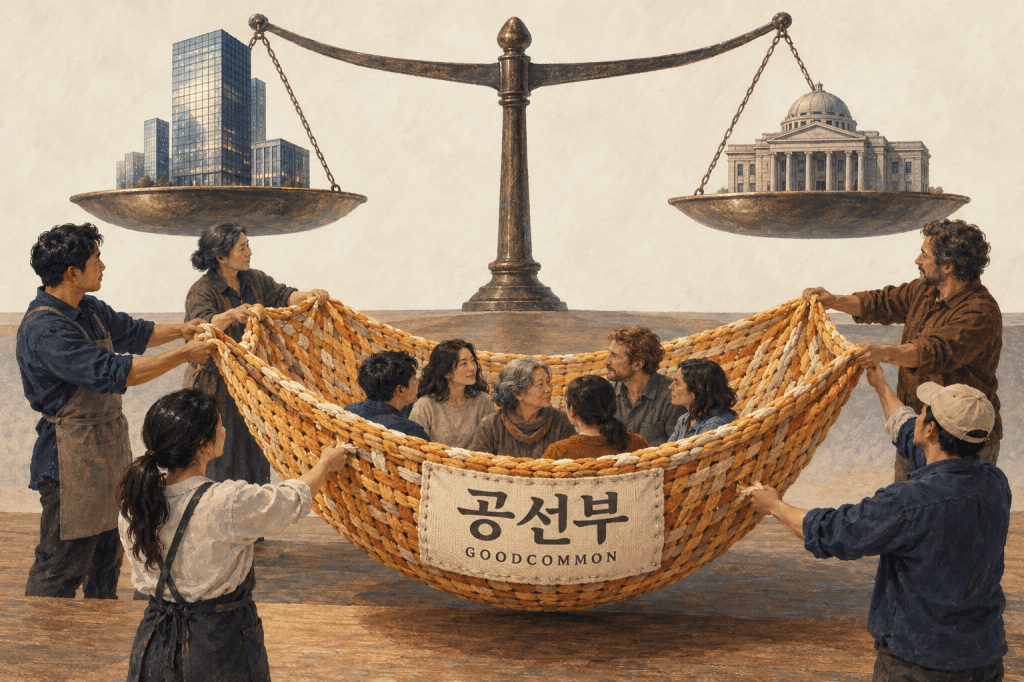
It is an entity with self-sustainability and expansiveness. Therefore, in the pursuit of common good separate from the market and government (legislative, judicial, administrative), it is proposed to call it Gongsunbu (Goodcommon). The word “Gongsunbu” is a Korean word that implies a comprehensive and integrated system of all the organizations working for common goods. One may create a new English word such as “Goodcommon”, meaning a common place where all the goodness activities are taking place. It contrasts to the word “Government” that carries the meaning of the system in which all the public matters are governed in that place.
As mentioned, while neoliberalism, represented by the so-called Washington Consensus, has been leading the global economic order since the 1980s, the essential altruistic and empathetic elements that must inevitably exist within the capitalist market order have not received much attention. However, by incorporating moral sentiment theories like those of Smith, ethical theories like those of Levinas, the altruistic spirit found in Eastern philosophy such as Motzu, the Hongik spirit ingrained in Korean life philosophy, Naohiko’s theory of sharing economy, and Jeremy Rifkin’s theory of distributive capitalism, it is clear that altruism and empathetic logic are firmly established as essential factors in the essence of capitalism. Therefore, the free laissez-faire market order should evolve to include these elements. Now, in order to explore the potential of Gongsunbu (共善府), let us first consider whether such a system can be implemented in a country that adopts capitalism, using Korea as an example of a representative case of modern capitalist systems.
VI. Role of Gongsunbu (Goodcommon)
If we were to divide the development history of Korean capitalism into 10-year intervals, we could name the periods as follows: the poverty alleviation period in the early 1960s to 1970s, the high-growth period in the early 1970s to 1980s, the market opening period in the early 1980s to 1990s, the globalization (neo-liberalism) period in the early 1990s to 2000s, and the welfare debate period since the 2000s.
Coincidentally, theories criticizing neoliberalism that points out the seriousness of the problem of “inequality” in market economies have emerged globally since the early 2000s, not only in Korea, but also in many other leading countries. With the advent of the Roh Moo-hyun government in the early 2000s, issues of polarization, inequality between large and small-medium enterprises, and the clash between growth-oriented policies and distribution-oriented policies became apparent. For the similar reason, one could argue that the history of capitalism is opening up a fairly significant new transitionary chapter in many countries. If Korean economists can devise institutional mechanisms to proactively address the issue of “inequality” in capitalism that has emerged globally, it could be a crucial turning point of the world economy because Korea has gone through all different stages of capitalistic development within such a short period of time.
Here, we can consider a new system. Evolving from the dichotomous system of government versus market, we can explore a tripartite system consisting of government, market, and Gongsunbu (공선부: 共善府: Goodcommon). The role of the government in relation to the market remains the same, where it regulates the market order through laws and taxation. However, in this new system, a country opens up and recognizes an entirely new entity to take on the task of fostering and nurturing an atmosphere of empathy, sympathy, coexistence, public good, benevolence, leadership for the underprivileged, and guiding the unfortunate, which the government has been unable to treat sufficiently so far. The Gongsunbu (Goodcommon) would be assigned the following missions:
(1) Define specifically what constitutes a good deed in the market (including producers and consumers). In particular, the Gongsunbu stipulates financial contribution as essential and is granted the ability to manage donated funds financially.
(2) Operate programs that encourage social contributions, volunteer work, support for vulnerable groups, and self-sacrifice even outside the market.
(3) Record the good deeds (or donation amounts) of producers and consumers individually and regularly notify them of their cumulative scores.
(4) Encourage reporting of good deeds for (3) above, issue a certificate to the contributors after verifying the reported deeds, praising their contributions.
(5) The organization regularly recommends citizens who have performed notable good deeds to receive certain benefits from the government.
(6) Establish financial institutions within the organization and grant the authority to increase funds necessary for promoting joint good deeds.
(7) Set up a public reporting system that both producers and consumers can use for matters that are difficult to resolve through laws.
(8) Actively seek empathy through compromise, negotiation,
mediation, and concession in resolving difficult issues received in (7) through private means.
(9) The operation of this organization is periodically reviewed by the National Assembly, the representative body of the people, if necessary.
Currently, there are many institutions and organizations in Korea that claim to pursue the common good of society. These include various non-governmental organizations (NGOs), media institutions, religious organizations, and various civic associations.
According to Levinas and Motzu, first, it is emphasized that good deeds and the pursuit of the common good have a significant self-propagating effect. When someone does a good deed first, it has a multiplier effect. That is, in human society, individuals who put good deeds into practice play a pivotal role in spreading goodwill among people, and the society fulfills this role more effectively.
Second, it would be ideal for acts of benevolence, virtue, and public service to be carried out without any expectation of reward. However, as pointed out by Levinas, the examination and confirmation of whether one’s contributions truly make the other person happy often result in making the contributor happier than not doing so. Therefore, it is necessary for some organization to be responsible for assessing and publicizing the effects of these contributions. Just as there are prices in the market, in Gongsunbu (Goodcommon), there should be a system to evaluate the effects of contributions and to establish criteria for expressing gratitude in cooperation with the government. In other words, just as there are prices in the market, there is a public certification of contributions in acts of benevolence.
VII. Possibilities of Gongsunbu (Goodcommon)
Is it truly possible for a new capitalist system composed of the government, the market, and the Gongsunbu (Goodcommon) to exist? This study believes that this task of creating a new capitalist system is by no means an easy task. However, there may be two arguments here. One is the absolute necessity of amending the constitution through the formal legislative process to establish the Gongsunbu (Goodcommon) as an officially recognized organization of the state. The other argument suggests that it is possible for private organizations that recognize the need for the Gongsunbu (Goodcommon) to voluntarily gather and operate purely in the private sector without going through the complex and arduous process of amending the constitution. Since the current constitution guarantees freedom of speech, assembly, and association for all citizens, it is possible to establish the Gongsunbu (Goodcommon) as a nationwide or an international private organization and simply register it with the government or United Nations according to existing laws.
To test whether the second option above is possible, this study looked at various private organizations that already exist in various parts of the world, based on the premise that the pursuit of the common good is inherent in human nature and would be more effective if it were left to private hands or some third-party driving force in cooperation with governments and/or international organizations. We looked at Habitat for Humanity in the United States, Samaritans in the United Kingdom, Akshaya Patra in India, the microcredit movement in Bangladesh, the Red Cross in Kenya, Fruits of Love in South Korea, and the international private organizations such as Rotary International, the Lions Club, and United Way Worldwide.[10] What this study concluded from this is that purely private organizations, not markets or governments, are working hard to overcome the challenges of the capitalist system, and they are doing so with remarkable effectiveness even though the total magnitude of their services is so far not so big to draw sufficient and viable attention from the public in general.
The deepest concern is that, despite there are various private organizations both domestically and internationally aiming towards common good, they are not influential enough to bring about the visible effects of addressing the inherent problems of the capitalist system. Therefore, it may be argued that it is desirable to first officially establish and operate a national and/or international think tank that is able to design the most effective type of Gongsunbu (Goodcommon) that could work effectively in major capitalist countries. Especially, the role of the think tank should include the mission to discover ways and means that will create the impetus for forming the Gongsunbu and operating it
The think-tank may consist of those economists who are internationally highly recognized scholars who have already revealed their concerns about the problems of conventional capitalism, some of whom have even proposed already certain constructive ways of reforming the current system so that it includes a visible mechanism inducing common good services to be activated in the economy. Through the very professional research, the new unit could be born that will attract positive responses from the public of current capitalist countries.
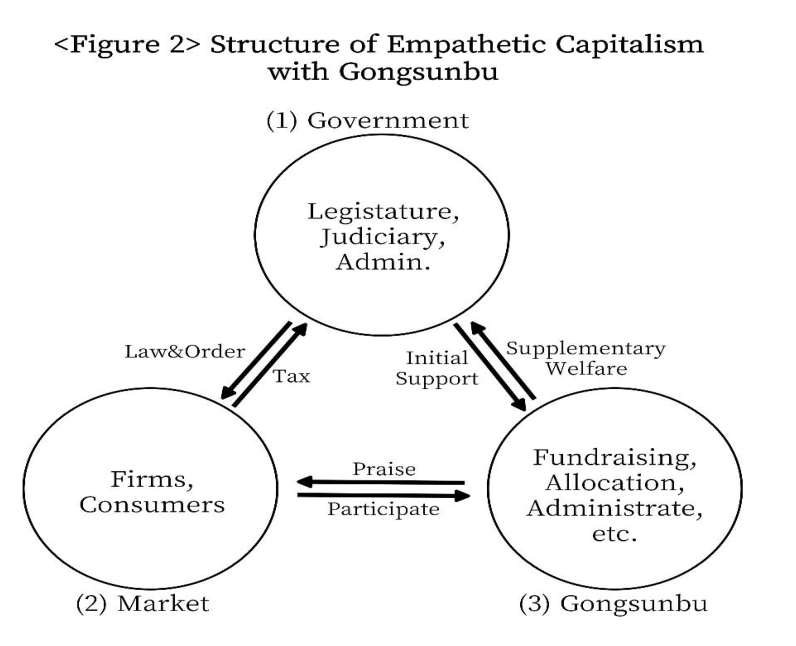
The structural position of Gongsunbu (Goodcommon) explained above is shown in <Figure 2>. There are three units in a nation: market, government (including a legislative, a judiciary, and an administrative unit), and Gongsunbu (Goodcommon). The last one’s missions have already been listed in Chapter VI above. In <Figure 2>, interactions among the three units are explained by using arrows. The relationship between the government unit and the Gongsunbu unit includes, first, the former provides the latter with necessary initial founding services just at its beginning stage, and second, the latter will take a good portion of nation’s welfare responsibility by helping out the government unit.
The relationship between the market unit and the Gongsunbu unit is, first, the former participates in the latter voluntarily and pro-actively to have its constituents (individuals and firms) contribute their efforts and financial supports to the latter, and second, the latter provides information of the donors and contributors and make it public so that their goodness behavior gets to be widely known throughout the society.
VIII. Conclusion
The history of capitalist market economies over the past 250 years is a history of success in terms of economic growth and development, but it is not a history of satisfactory success in terms of distribution and well-being. Countries that have faithfully relied on capitalist theory are faced with such problems as inequality, disparity between the rich and the poor, monopolies, the possibility of market failure, unfocused government economic policies, lack of adequate reserves for business cycles, failure of hierarchical management, and weaknesses in environmental protection, and so on, and cannot confidently say that they have succeeded in creating or maintaining an equal economy, balanced growth, just distribution, and a peaceful society.
The theory of conventional capitalist economy is based upon free market economy, guaranteed private property rights, and maximization of profits which began with Adam Smith’s “The Wealth of Nations”. It may have provided a desirable economic solution when human beings were considered as beings who pursue only utility and profit, but human nature is not driven by selfish motives alone, but by the pursuit of the common good as well. If we acknowledge human nature as a social animal, as a good being with inherent altruism, and as a gentle being who prefers to cooperate with neighbors, one can create a capitalist society that promotes coexistence, collective happiness, shared achievements, and voluntary service while engaging in free competition.
In order to test this hypothesis, this study revisited Motzu’s theory of self-interested altruism and universal love and other related theories.
Interpreting the market as a community in which various individuals are living together, institutional economics proposed by Acemoglu, Simon Johnson, James Robinson, and others should be given keen attention and one may find that whether or not a country can creatively develop institutions that can mitigate the differences in education, efficiency, mechanization, productivity, etc. will become a very important question. In addition, the ethical theory of Emmanuel Levinas, who made his name in France in the early 20th century, was deemed to have sufficient merit, recognizing that the logic of altruistic coexistence, which was thought to be difficult in capitalist societies, is quite applicable to the current society. This study also found many implications from Naohiko Jino’s sharing economy that faces the human ecosystem, which has recently begun to receive attention.
This study also examined the religious approach of Rerum Novarum doctrine that argued based on the absolute principle of human dignity, both the greed of capitalism and the logic of absolute equality attempted by socialism should be scrapped and a new society with justice, public welfare, love, and compassion in people’s hearts should emerge. This is what Pope Leo XIII in the late 19th century called compassionate capitalism.
Some scholars argue that the climate of competition and egoistic market behavior can be transformed into one of cooperative and altruistic behavior. Jeremy Rifkin is a prominent example who argues that recent rapid advances in science and technology have enabled digital solutions and artificial intelligence (AI) methods to change the way markets operate, which previously relied solely on the law of supply and demand.
It has become a world where consumers and producers can engage in various economic activities beyond the barriers of time and space using large-scale collaborative methods. This new system of capitalism is called distributive capitalism, and he believes that this revolution will take place throughout the 21st century. If such a change is realized, he believes that humans will leave the realm of maximization of self-interest and instead create a system where everyone can benefit. In other words, he argues that humanity will seek a better capitalism by unleashing the instinct for the common good that is already inherent in human nature.
One of the main points of this study is that the private sector has a big role to play in solving the problems of capitalism. We looked at private charities and volunteer organizations that already exist in various parts of the world, based on the premise that the pursuit of the common good is inherent in human nature and would be more effective if it were left to private organizations or some third-party driving force rather than to governments. We looked at Habitat for Humanity in the United States, Samaritans in the United Kingdom, Akshaya Patra in India, the microcredit movement in Bangladesh, the Red Cross in Kenya, Fruits of Love in South Korea, and the international private organizations such as Rotary International, the Lions Club, and United Way Worldwide.
What this study concluded from this is that purely private organizations, not markets or governments, are working hard to overcome the challenges of the capitalist system, and they are doing so with remarkable effectiveness even though the total magnitude of their services is so far not so big to draw sufficient and viable attention from the public in general.
If we see that the private sector is working hard to make society brighter, cleaner, more equal, and less divided, and that it is working, we might then suggest that we create new institutions at the national level to spread these good deeds and philanthropic efforts and make them work for the benefit of the entire population. In this study, it was proposed that the world would assign a mission to a group of prominent economists, one may call it an international think-tank, to design a new capitalist economy with an empathetic unit that takes the responsibility for narrowing the gap between haves and have-nots.
While leaving the big job to the international think-tank, this study decided to go one small step earlier to propose that the country’s economic system should have an independent body, called Gongsunbu (Goodcommon) in addition to the market and the government (legislative, judicial, and administrative).
Gongsunbu is strictly a private sector organization. It would be an integrated organization of existing voluntary organizations, charity organizations, religious groups, various associations, and any other private systems that want to play a role in making our society a fairer, more harmonious, and more generous place. When Gongsunbu is created, the leadership of these organizations can work together with the government to provide some initial support to get it off the ground. It is given six functions: collection, application, administration, promotion, finance, and corporation.
There is a good reason why Gongsunbu is given a financial function. Although it is an organization created for the purpose of volunteerism, charity, benevolence, and relief, it must have financial resources to support it in order to function properly. Therefore, it must have a professional umbrella organization that can properly manage donations from all over the country. The accumulated funds should be invested in a reasonably profitable way to grow them. This is not a typical financial business, but an investment that is necessary for the operation of the public sector and to direct the available funds towards the needy in society. Just as the government has a financial regulator, one may consider having an investment regulator within Gongsunbu.
Compensating for the weaknesses of the capitalist system by establishing Gongsunbu should relate to a country’s constitutional system, and therefore it is an extremely technical issue and is beyond the scope of this study. However, the general proposition identified in this study, namely, that human societies have an inherently virtuous nature to help, rely on, and coexist with each other, has been identified in various existing papers and books, and in addition, the fourth industrial revolution currently underway has been characterized by knowledge sharing, information sharing, and network sharing. This study concludes that if we recognize this human nature and technological innovation together, economists can creatively devise some workable empathetic capitalist system together with the market and the government.
Finally, while this study hopes that a world official power such as U.N. will take the lead in the movement to establish a third unit, such as Gongsunbu, an alternative route would be that a typical capitalist country that has a long history empathetic philosophy of economics, such as Korea, could be an examining place where this bold idea could carefully be implemented. [THE END]
Footnotes
[1] Rifkin, Jeremy, The Empathic Civilization, The Race to Global Consciousness in a World in Crisis, Penguin Pub. Co., 2009
[2] Lovelock, James, Gaia: The Practical Science of Planetary Medicine, Oxford University Press, 2001
[3] See Levinas E. (op.cit.), and Naohiko, Jino., There Comes the“Sharing Economics”, (translated by Jeong, Kwangmin), Epac P&P, Seoul, 2013, Motzu (墨子) (translated by Kim, Hyungchan), Hongik Pub. Co., Seoul, 2004, and Kim, Yongbok, The Philosophy of Hongik Humanism, Tongnamu, Seoul, 2004.
[4] See Chae, Sangwoo, “A Faceless Angel: Jeonju City’s Anonymous Giver,” Herald Economy (in Korean), December 20, 2024.
[5] Naohiko (op. cit.)
[6] “Wakachiai No Keizaigaku” can be translated into “Economics of Sharing”.
[7] See Mencius (孟子)(translated by Kim, Hyungchan), Hongik Pub. Co., Seoul, 2004 and Analects of Confucius (孔子: 論語)(translated by Shin, Dongjun), Wisdom House, Seoul, 2016
[8] See Mencius (孟子), Footnote 7.
[9] Rifkin, Jeremy (op. cit)
[10] A detailed explanation of various voluntary organizations and their contributions is found in Yoo, Jang-Hee, A Theory of Empathetic Capitalism, NAS, Seoul, 2025.
References:
1. Andreoni, J., “Impure Altruism and Donations to Public Goods: a Theory of Warm-glow Giving”, Economic Journal 100:464-477, 1990
2. Acemoglu, Daron and Robinson, James, Why Nations Fail: The Origins of Power, Prosperity and Poverty, Random House, 2012.
3. Becker, G.S., “Notes on an Economic Analysis of Philanthropy”, National Bureau of Economic Research, Research Paper, 1961
4. Becker, G.S., “Altruism, Egoism and Genetic Fitness: Economics and Sociobiology”, Journal of Economic Literature 13:817-826, 1976
5. Becker, G.S., “Altruism in the Family and Selfishness in the Market Place”, Journal of Econometrics 48:1-15, 1981
6. Boushey, Heather, Unbound: How Inequality Constricts Our Economy and What We Can Do About It, Harvard University Press, 2019.
7. Chae, Sangwoo, “A Faceless Angel: Jeonju City’s Anonymous Giver”, Herald Economy, December 20, 2024
8. Collard, D., Altruism and the Economy. A Study in Non-Selfish Economics Martin Robertson, Oxford, 1978.
9. Danner, P.L., “Sympathy and Exchangeable Value: Keys to Adam Smith’s Social Philosophy”, Review of Social Economy 34(3):317-331, 1973
10. Dawkins, Richard, The Selfish Gene (translated by Young Hong), Oxford University Press, 1976.
11. Deaton, Angus, Deaths of Despair and the Future of Capitalism, Princeton University Press, 2020.
12. Douglas, J., Why Charity? The Case for a Third Sector, Sage Publications, Beverly Hills, 1983.
13. Fukuyama F., The End of History and the Last Man, Free Press, New York, 1992.
14. Hammond, P., “Charity: Altruism or Egoism?”, in E. Phelps, ed., Altruism, Morality, and Economic Theory, Russell Sage Foundation, New York, 1975.
15. Kaletsky A., Capitalism 4.0(The Birth of a new Economy in the Aftermath of Crisis), Public Affairs, New York, 2010
16. Kennett, D.A., “Altruism and Economic Behavior”, American Journal of Economics and Sociology 39(2), 1980.
17. Kolm, S.-Ch.(1987b), “The Freedom and Consensus Normative Theory of the State: The Liberal Social Contract”, in P. Koslowski, ed., Individual Liberty and Democratic Decision-Making: The Ethics, Economics and Politics of Democracy (J.C.B, Tubingen)97-127.
18. Kramer, Larry, Beyond Neoliberalism, Rethinking Political Economy, Hewlett Foundation, April 26, 2018.
19. Kranich, L., “Altruism and efficiency: a welfare analysis of the Walrasian mechanism with transfers”, Journal of Public Economics 36:369-386, 1998.
20. Levinas E., Autrement qu’ être ou Au-dela de l’essence, The Hague and Boston: Martinus Nijhoff, 1975
21. Lovelock, James, Gaia: The Practical Science of Planetary Medicine, Oxford University Press, 1991 & 2001
22. Milanovic, Branko, Global Inequality: A New Approach for the Age of Globalization, Belknap, Harvard University Press, 2018.
23. McKean, Richard, “Private Charity and Public Policy”, Paper Presented to the Library Fund Seminar, Miami, April 1979.
24. Mozi (墨子), Theory of Mozi’s Companion Love (兼愛), Ulyumunhwa, Seoul, 2019
25. Naohiko, Jino, There Comes the “Sharing Economics” (translated by Kwangmin Jeong), Epack P&P, Seoul, 2013
26. Niebuhr, Richard H., The Responsible Self: An Essay in Christian Moral Philosophy, Westminster John Knox Press, 1999.
27. Phelps E., Altruism, Morality, and Economic Theory, (Russell Sage, New York, 1975)
28. Thomas Piketty, Capital in the 21st Century, Harvard University Press, 2014.
29. Rajan, Raghuram G., The Third Pillar: How Markets and the State Leave Community Behind, Penguin Press, 2019.
30. Rifkin, Jeremy, The Empathic Civilization, The Race to Global Consciousness in a World in Crisis, Penguin Pub. Co., 2009
31. Saez, Emmanuel and Zucman, Gabriel, “Distributional National Accounts: Methods and Estimates for the United States”, Quarterly Journal of Economics, 133, 2018.
32. Schumacher, E. F., Small is Beautiful: A Study of Economics as if People Mattered, Blond & Briggs, New York, 1973.
33. Scott, R.H., “Avarice, Altruism, and Second Party Preferences”, Quarterly Journal of Economics 86:1-18, 1972.
34. Smith A., The Theory of Moral Sentiments, Stand & Bell, Edinburgh, 1759.
35. Smith A., The Wealth of Nations, W. Strahan & T. Cadell, London, 1776.
36. Stiglitz, Joseph, Price of Inequality, W.W. Norton Co., New York, 2012.
37. Tetreau, Edouard, Au-Dela du mur de L’argent, Bona Liber Cooperative, Ltd., 2016.
38. Tocqueville, Alexis de, Democracy in America, Saunders & Otley, London, 1838.
39. Toynbee, Arnold J., Survive the Future, Oxford University Press, 1971
40. Vickrey, W.S., “One Economist’s View of Philanthropy”, in F. Dickinson, ed., Philanthropy and Public Policy, National Bureau of Economic Research: New York, 1962.
41. Weber, Max, The Protestant Ethics and Spirit of Capitalism, 1904.
42. Wilkinson, R., and Pickett, K., The Spirit Level: Why More Equal Societies Almost Always Do Better, Allen Lane, Bloomsburg Press, 2019
43. Wolff, Richard D., The Sickness is the System, Democracy at Work, New York, 2020.
44. Yoo, Jang-Hee, A Theory of Empathetic Capitalism, NAS, Seoul, 2025.
45. Zamagni, S., ed., The Economics of Altruism, Edward Elgar, Cheltenham, 1995.
Jang-Hee Yoo
B.A. in Economics, Seoul National University; M.A. in Economics, UCLA; Ph.D. in Economics, Texas A&M University.
Dr. Yoo served as a professor of economics at Clark University (1972–1976), Virginia Commonwealth University (1976–1988), and Seoul National University (1988–1989). He served as President of the Korea Institute for International Economic Policy (1989–1997), Dean of the Graduate School of International Studies at Ewha Womans University (1997–2004), and Vice President of Ewha Womans University (2004–2006).
He also served as a member of APEC’s Eminent Persons Group (1998–2001), Chair of the ROK Government’s Foreign Policy Advisory Council (1998), Chair of the National Assembly Budget Office Advisory Committee (2004), President of the Korean Economic Association (2003), Vice Chairman of the National Economic Advisory Council (2011), and President of BBB Korea (2011).
Dr. Yoo authored Macroeconomic Theory (1975), New Currents of Economics (1985), APEC and the New International Order (2005), New Light over the Limit (2008), Privatized Republic (2008), and other works.
[Editor’s Note: In 2022, a rare event occurred in the world of economists, many (if not all) of whom our opinion columnist Yeomin Yoon regards as a “confused, sophomoric species.” The Korean Association of Poets officially recognized the prominent Korean economist Yoo as a poet at a major gathering of Korean poets. The Association awarded Dr. Yoo a plaque (등단패), formally recognizing him as a “real poet.”
The Association recognized four people, including Dr. Yoo, as “new poets.” The combined ages of the other three new poets—23, 25, and 31—did not even equal Dr. Yoo’s age. This economist-poet, a rare combination, confessed: “I felt like an old man enrolling in elementary school as a student.”]


Leave a comment