Table of Contents:
Summary
Summary in 한글
I. Introduction
II. The United Nations Universal Declaration of Human Rights
III. Should property rights be subordinated to the common good?
IV. Is private property the source of freedom?
V. Looking at freedom and responsibility from the angle of humans’ vertical
and horizontal connectivity
VI. Closing remarks
Author’s biographical information
Summary: The history of the debate regarding human rights is not old but a recent phenomenon. The debate over property rights, however, is very old. One can trace the debate over markets and property rights to Plato and Aristotle. Many mainstream (Anglo-American) economists regard property rights as an absolute human right. Property rights are derivative rights. Moreover, I would agree with the common American proclamation, “Private property is the source of freedom in America,” if it were combined with another proclamation: “Freedom should be accompanied by responsibility.” Property rights should be evaluated on the foundation of the two pillars of a decent human society, freedom and responsibility. Human morality affirms freedom and responsibility, rendering civilization civilized. Freedom without responsibility is, at best, indulgence. Continued demands of freedom devoid of responsibility will aggravate environmental degradation and the depletion of natural resources, which will most likely lead to the eventual demise of the human species living on the small spaceship called the “Blue Marble.”Additionally, plutocratic properties are not truly private properties. They are privately controlled public properties. In a democracy, they should be either reduced to genuinely private
property through due process or publicly controlled. [Keywords: capitalism; democracy;
freedom; human rights, plutocracy; property rights]
Summary in 한글: 인권에 관한 논쟁의 역사는 그리 길지 않고, 비교적 최근에 나타난 현상입니다. 그러나, 재산권에 관한 논쟁은 역사가 매우 깊습니다. 시장과 재산권을 둘러싼 논의는 적어도 플라톤과 아리스토텔레스 시대까지 거슬러 올라갑니다. 주류 (영미, Anglo-American) 경제학자 중 다수는 재산권을 절대적인 인권으로 간주합니다. 그러나 필자는 재산권이 절대적 권리가 아니라 파생적 권리라고 주장합니다. 더 나아가, “사유재산은 미국의 자유의 원천이다”라는 흔한 미국인들의 주장에 동의하지만, “자유에는 책임이 수반되어야 한다”라는 또 다른 주장이 덧붙여져야 한다고, 필자는 생각합니다. 재산권은 건전한 인간 사회의 두 기둥, 즉 자유와 책임을 바탕으로 평가되어야 합니다. 인간의 도덕성은 자유와 책임을 긍정하며, 이를 통해 문명이 완성됩니다. 책임 없는 자유는 기껏해야 방종일 뿐입니다. 책임감 없는 자유에 대한 지속적인 요구는 환경 파괴와 천연자원 고갈을 심화시킬 것이며, 이는 결국 “푸른 구슬”이라 불리는 작은 우주선에 살고 있는 인류의 멸망으로 이어질 가능성이 매우 높습니다. 필자는 오늘날의 미국을 민주주의 국가라기 보다는 금권주의 국가로 봅니다. 필자는, 또한, 금권주의적 성격의 재산은 진정한 의미의 사유 재산이 아니라고 주장합니다. 그러한 재산은 사적으로 통제되는 공적 재산에 불과하다고 봅니다. 민주주의 사회라면 이러한 재산은 적법한 절차를 거쳐 진정한 사유 재산으로 환원되거나, 아니면 공적으로 통제되어야 합니다.
핵심어: 금권주의, 민주주의, 인권, 자본주의, 자유, 재산권, 책임]
I. Introduction
How the government of a nation treats its people and how the people treat one another has become a measure of the nation’s respectability. A nation may be powerful and hence feared or depended upon; a nation may be rich and favored as a trade partner. However, neither power norutility elicits respect without corresponding ethical respectability which calls for respect for
human rights. But the history of the debate regarding human rights is not old but a recent phenomenon. For example, the well-known “The United Nations Universal Declaration of Human Rights” was proclaimed in 1948. It was a distillation of humankind’s long and chastening historical experience.
In contrast, the debate over property rights is very old. We can trace the debate over markets and property rights to Plato and Aristotle. According to Karl Popper (Austrian–British philosopher, academic, and social commentator, 1902 – 1994), Marxism might be seen as merely a “theory revived” from the communism (common ownership of properties) of Plato’s Republic. Both Plato and Marx offered a vision of an “apocalyptic revolution which will radically transfigure the whole social world.”
By contrast, Plato’s student Aristotle was more concerned with satisfying the pragmatic requirements for living in the world as it exists, where property rights have the great advantage that “when everyone has a distinct interest, men will not complain of one another, and they will make more progress because everyone is attending to his own business.” (Aristotle, The Politics) Where things are held in common, “those who labor much and get little will necessarily complain if those of who labor little and receive or consume much.”
In the above quotations, Aristotle was apparently referring to the concept of “tragedy of the commons,” although he did not coin this phrase. “Tragedy of the Commons”, which was first used by an American ecologist and microbiologist Garrett Hardin (1915-2003) in 1968, describes how shared environmental resources are overused and eventually depleted.
The practical usefulness of property rights in organizing society is not a recent insight. However, commons governance has also proven viable for a long period in many countries, including Korea. For example, consider a village well shared by all villagers in Korea’s countryside. It is neither “private property” owned by private agents nor a class of inherently “public property” controlled or managed by any government. It is collectively “owned and
managed” by villagers (or society at large).
Apparently, many people governed by industrial capitalism in recent centuries have lost touch with the customary right to access to commons. As an unfortunate result, in my opinion, they (e.g., Americans) have become so attached to the idea that all nature is a resource to be extracted and propertied in pursuit of each individual’s self-interest at the exclusion of others. Many visitors to Alpine communities in Europe (Austria, France, Germany, Italy, and Switzerland) note that these communities have uccessfully governed and managed their self-regulated commons for many centuries.
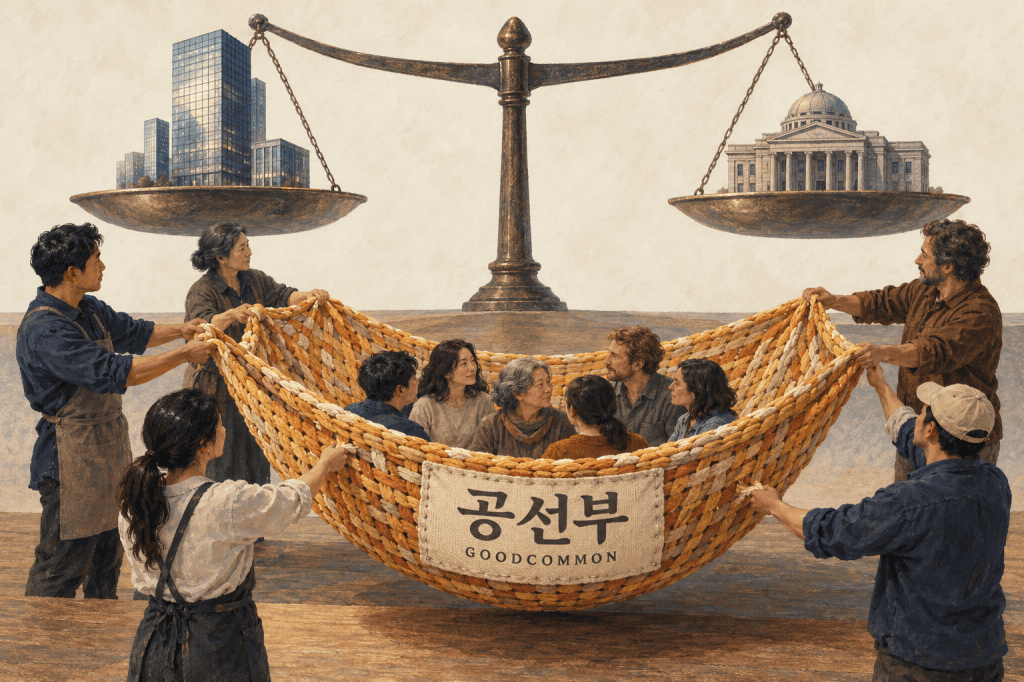
In this context, the idea for establishing 공선부 (共善府, Good Commons) proposed by Dr. Jang-Hee Yoo, a distinguished member of the National Academy of Sciences of Korea, deserves wide support from the Korean society that is plagued by extreme economic inequality and one of the highest suicide rates among OECD (aka, rich-country club) countries, notwithstanding alleged industrial success in recent decades. (See Dr. Yoo’s article, “The
Modern Capitalism: What Should Come Next?” Diaspora, October 3, 2026.)
II. The United Nations Universal Declaration of Human Rights
The United Nations Universal Declaration of Human Rights (General Assembly Resolution 217A, December 10, 1948; UDHR for short) included property rights as a human right. Basic rights that belong to a person as a consequence of being human, for example, are:
• Right to life — Every human being has the inherent right to life or to be. No one shall be arbitrarily deprived of his/her life.
• Freedom from torture
• Freedom from slavery
These rights are more fundamental than others. By the late 20th century, it had generally come to be agreed that all human beings are entitled to some basic (fundamental) rights, marking the birth of the international and universal recognition of human rights. But the scope of those rights remains the subject of dispute.
The UDHR (Universal Declaration of Human Rights) regarding property right can be summarized as follows:
Article 17
• Section 1. Everyone has the right to own property, whether alone or in ssociation with others.
• Section 2. No one shall be arbitrarily deprived of his property.
Based on UDHR Article 17, many mainstream (Anglo-American) economists tend to regard property rights as an absolute human right. One of the most fundamental concepts of economics and business is property. Is the property right an absolute human right as commonly believed by mainstream economists?
I don’t believe so. A human right is the right of a human being to be and to live with dignity commensurate with his or her intrinsic worth. The property right is the right to possess non-human objects that are not originally part of oneself. A community can provide human rights to its members even if properties are held in common.
According to Section 1 of Article 17 of UDHR: Everyone has the right to own property alone as well as in association with others. It needs interpretation:
“The right to own X,” where X is not part of a person, practically means the right to use X, provided his/her use of X does not harm others. Consider the state of nature where the strongest person declares to all neighbors that the entire land reaching their horizons is his/hers and that they should not use any part of the land or anything living or growing on it without his/her permission. Does Article 17 approve it? I doubt it.
In other words, the concept of property ownership is incompletely determined without or before a principle of just distribution is incorporated thereunto. A property is not a true part of a person. A human being does not own his parts — eyes, arms, legs, heart, etc. — constitute him. The integrity of a person (body, mind, and soul) is his true (absolute) right. If a person has acquired his property (say, his grandiose mansion in Florida or New Jersey) in an unsavory way, is his right to that property a human right?
Section 2 of Article 17, “No one shall be arbitrarily deprived of his property,” also needs interpretation. I uphold Section 2 if the system of property is assumed just. If exclusive ownership of land (or natural resources) and its (or their) products is a deprivation of others of their share, a huge question is begged: what legitimates a person’s claim to property?
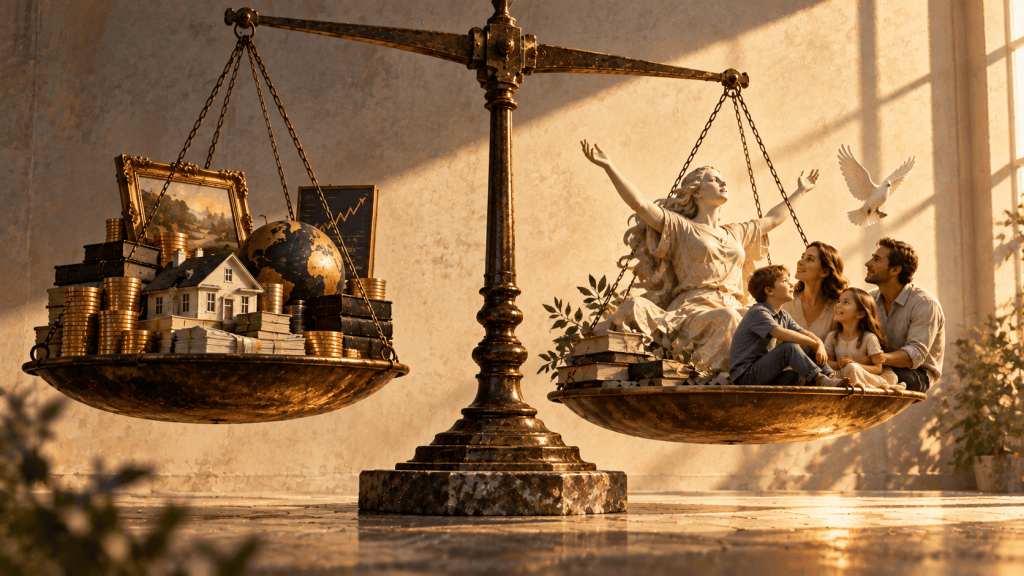
I believe that property – what mainstream economists call the most fundamental concept of economics and business — is an ethical concept. A related ethical question is: Should property rights be subordinated to the common good?
III. Should property rights be subordinated to the common good?
The common good is a state of the system – the sum (or, total) of appropriate institutional arrangements that guarantee, enable, and facilitate human flourishing. As a (heterodox) economist, I endorse without any hesitation the notion that the common good is central to the good society. To me, the UN Universal Declaration of Human Rights is an outline of the common good, sketching the various individual well-being in the global community. Therefore, I endorse the priority of the common possession of the goods of the earth over a legitimate, but derivative, right to private property.
IV. Is private property the source of freedom?
I have found that many Americans believe and proclaim that “Private property is the source o freedom in America.” They also tend to think that such belief or proclamation would be supported by John Stuart Mill, British philosopher, economist, moral, and political theorist (1806-1873). Mill said: “Nothing is implied in property but the right of each to his faculties, to what he can produce by them, and to whatever he can get for them in a fair market.” I am sharing with the readers the comments I make when I encounter such Americans.
Let me start with my observations of historical reality:
- History seems to agree with former US Secretary of Labor, Robert B. Reich, who said: There are five ways to accumulate private property in the order of a billion dollars: (i) profiting from a monopoly, (ii) insider trading, (iii) political payoffs, (iv) fraud, and (v) inheritance. He proclaimed: “Don’t believe the self-made myth.” Reich’s proclamation reminds me of a story (or joke) I used to tell students in my international finance classes:
“Once upon a time, an old man was explaining to a young man how he was smart and became rich. He bragged as if he were a retired, drunk pirate: ‘Inspired by the teaching espoused by mainstream (or American Neoliberal) economics, I maximized my profits — admiring the Neoliberal version of creative destruction, the essential fact about the rootin’-tootin’ Wild West American capitalism. I ignored natural capital (the cosystems). I ignored people whom economists called human capital. I burned through natural resources and burned through people to create ever-greater profit margins. The Neoliberal free market provided ample opportunities for me to gouge prices, skim profits, and plunder. I am now a self-made multi-millionaire. Am I not smart and rich?’ The young man
responded: ‘I am much smarter and richer than you are. I chose super-rich parents from whom I inherited a billion dollars before I became 30. You should have learned how to make money without really trying.’” [According to a Guardian article (April 3, 2024), “All billionaires under 30 have inherited their wealth.” Written by wealth correspondent Rupert Neate, the article notes: “Fifteen young billionaires are among the first wave of a $5.2tn transfer of wealth by the aging super-rich.”] - Indeed, immorality, iniquity, vileness, or wickedness tainted the cause of privat property. Progressive intellectuals regard America as a plutocracy rather than a democracy. John Stuart Mill would concur with the following three-part statement: (i) Plutocratic properties are not truly private properties. (ii) They are privately controlled public properties. (iii) In a democracy, they should be either reduced to genuinely private
properties through due process or publicly controlled. - When humans lack private property, they tend to yield to the tyranny of rulers without serious resistance; they do not dare resist in fear of destitution, i.e., the consequence of, say, the loss of livelihood their resistance to power is likely to trigger. According to Aristotle, “a moderate and sufficient property” enables citizens to resist absolute power and act the part of free men. Without the income such private property enerates, men would most likely subject their families and themselves to misery and squalor.
- It is understandable why many Americans regard private property as the source of freedom. They tend to deem the personal economic security of private property as the only dependable foundation of individual liberty. Many Americans seem to be proud of the “American conviction” that he (she) must be able to look anyone in the eye and tell him (her) to “go to hell” — which they presume as the essence of the free man’s (woman’s) way of life. It may be a truism that men (women) cannot be made free by laws (woman’s) way of life. It may be a truism that men (women) cannot be made free by laws unless they are free because no one can coerce them, and no one can buy them.
One of my favorite (Jewish) stories runs like this: Two men went out on the water in arowboat. One of them (say, person A) started to saw the floor under his feet, proclaiming that he had the freedom to do whatever he wished with the place that belonged to him. The other (person B) reminded person A of all boat riders’ responsibility as they were in the boat together; the hole person A was making would sink all of them in the boat.
I would agree with the common American proclamation, “Private property is the source of freedom in America,” if it were combined with another roclamation: “Freedom should be accompanied by responsibility.” As a human and an economist, I evaluate property rights from the perspective of the two pillars of a decent human society, freedom and responsibility.
In this context, let me quote Vaclav Havel, who served as the last president of Czechoslovakia (1989-1992) and the first president of the Czech Republic (1993-2003). In his address to the US Congress (on February 21, 1990), Havel stated: Regardless of nationality, we, humans, are still “incapable of understanding that the only genuine backbone of all our actions, if they are to be moral, is responsibility – responsibility to something higher than my family, my country, my company, my success” – my property, I might add.
I believe human morality affirms freedom and responsibility, rendering civilization civilized. Freedom without responsibility is, at best, indulgence. In my eyes, the former without the latter has led to avoidable ill-being in America – the ingrained and widening gap between rich and poor, continuing discrimination against minorities, religious and cultural intolerance, and political figures who corrupt laws and give a bad name to democratic politics.
I even dare to project that continued demands of freedom devoid of responsibility will aggravate environmental degradation and depletion of natural resources, which will most likely lead to the eventual demise of the human species living on the small spaceship called the “Blue Marble.”
V. Looking at freedom and responsibility from the angle of humans’ vertical and horizontal connectivity
I believe that humans should look at freedom and responsibility from the angle of humans’ vertical and horizontal connectivity. Such connectivity reflects Korean thinkers’ worldview and ethical foundation of their “Strive to Benefit Humanity” (홍익인간) ideal the South Korean government established as Article 1 of the National Education Charter in 1949.
Humans are connected (i) with the past and the future vertically through time, and (ii) with other humans horizontally through space. My past did not start on the day when I was born, and my future will not end on the day when I die. I inherited many things from the past through my relationship with my parents and grandparents, and therefore I did not “start” from me. I am not the only owner of “my past.” Likewise, the so-called “my future” is not “mine” only. I bequeath my heritage, accomplishments, and mistakes to my descendants; therefore, I do not end with my death. I continue to live through my descendants. The category of descendants includes biological, intellectual, moral, and spiritual ones.
The nexus of horizontal connectivity is to find my neighbors. If I look at my front, rear, left, and right, I find that I am not alone. The so-called “my body” is not mine only. I was born to my parents, specifically from my mother’s womb, and my body grew thanks to my mother’s milk and food provided to me by other people. Therefore, the so-called “mine” is not mine alone. I have lived, am living today, and shall live until my demise thanks to the favor or assistance from other people.
To put it plainly, what is “mine” is composed of things of “not mine.” Therefore, my vertical connectivity necessarily leads to recognizing my horizontal connectivity, i.e., the importance of finding my neighbors (including even those I may never meet personally) and recognizing my responsibility to help them flourish as humans. Finding and recognizing
neighbors is the foundation for many sages’ quests for peace in the world which requires acceptance of universal brotherhood/sisterhood and the ideal of serving and benefiting humanity (홍익인간사상). Serving and benefiting humanity may start from a specific country (say, South Korea) and will spread to the rest of the world if humans keep questing for autonomous and responsible men and women and communities that are indispensable for truly civilized civilizations — rather than either bonding themselves obsessively to the security and freedom individuals expect their private properties to provide, or collectively enriching the state and strengthening imperialistic military power (부국강병, 富國強兵).
I believe John Stuart Mill would agree with the following contention: I do not “own” the parts of my organism by birth – my eyes, arms, legs, or heart. They constitute me, a human being. The integrity of my body, mind, and soul is my absolute (fundamental) human right. But my private property, say, the house I built with my labor for my family and me, does not constitute me. If I use the terminology coined by Alfred J. Lotka, a physical biologist (1880- 1949), my house is merely an “exosomatic” (“pertaining to the outside of the body of an
organism”) instrument. To that instrument, I do have a legitimate, but derivative, right.
In summary, if we affirm humans’ vertical and horizontal connectivity, we also can realize the symbiotic relationship between freedom and responsibility in a decent society. Doing so would let us appreciate the importance of the common good, in addition to the significance of the right to private property as a derivative rather than a fundamental right, for our civilized living today and our descendants yet to be born.
VI. Closing remarks
In closing, may I share a few interrelated questions as food for thought?
- Aren’t humans too attached to private property, as if they were fastened to a mother or father who provided them with security and freedom when they were children? Why do millions of people expect to find security and freedom in their attachment – to their private property (e.g., their house), ideology, and country? Aren’t they willing to fight the rest of the world to protect their attachment? Where do you think humanity will end up if everybody is forever obsessed with his (her) immediate bond to the perceived sources of security and freedom?
- Shouldn’t we endorse the common possession of goods provided by the Earth, while recognizing a legitimate, but derivative, right to private property?
- Don’t we agree with Albert Einstein, who said: “Only a life lived for others is a life worthwhile”? Isn’t it through others that one finds one’s individuality? Isn’t it through others that one comes to appreciate the meaning of values and the value of meaning? Who and what should constitute “others”? [THE END]
Yeomin Yoon
Professor Emeritus, Seton Hall University
Opinion Columnist, Diaspora


Leave a Reply